01↗
TRUSTED SIGNALS
The product needed to communicate useful publisher signals without pretending to know metrics that cannot be verified from public evidence.
An evidence-first publisher due diligence platform designed to help guest-post and link buyers inspect publicly observable website signals before making a placement decision.
UI/UX × Development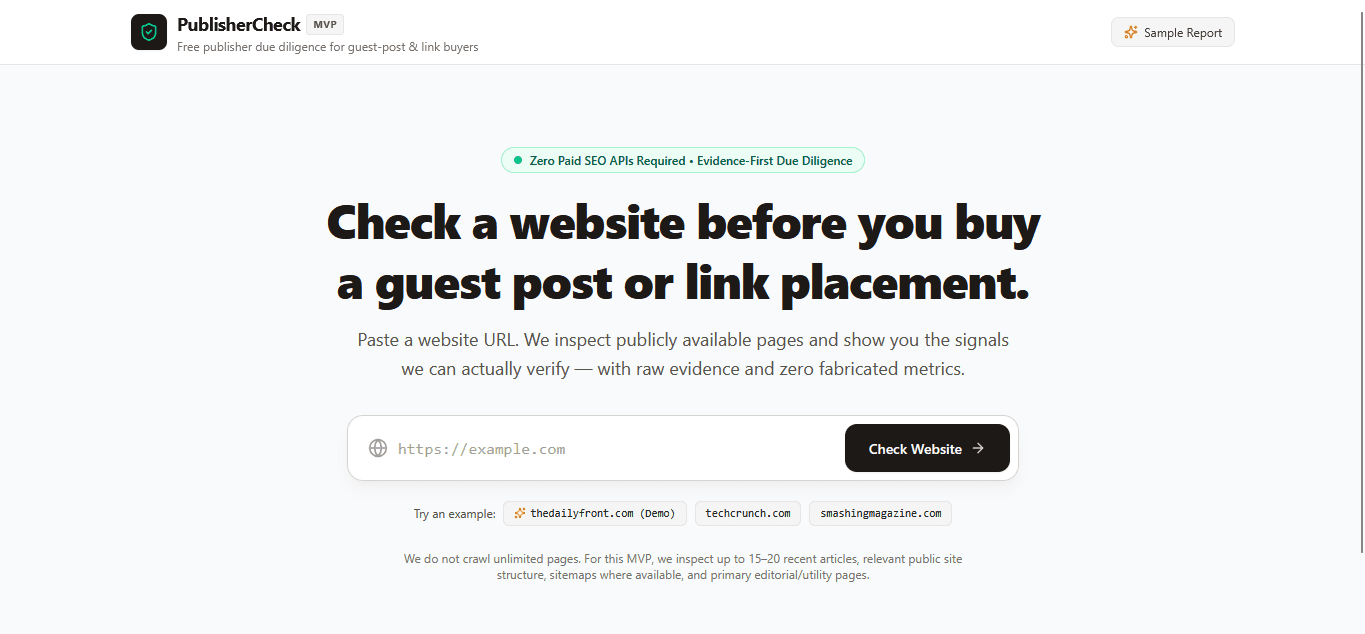
PublisherCheck is a browser-based due diligence tool for inspecting websites before buying guest posts or link placements.
Instead of presenting an arbitrary SEO score, the product focuses on signals that can actually be observed from publicly accessible pages and technical responses.
The report turns a potentially messy research task into a structured interface containing verified checks, site taxonomy, limitations and human-review guidance.
Visit the live project↗Publisher research often depends on scattered signals. The challenge was to make those signals understandable without manufacturing certainty.
The product needed to communicate useful publisher signals without pretending to know metrics that cannot be verified from public evidence.
Every automated result needed to be connected to observable public evidence instead of becoming another unexplained SEO score.
A website inspection can produce many different signals. The challenge was turning those signals into a report that remained easy to scan.
Automated checks cannot replace editorial judgment, so the interface needed to clearly separate machine-verified signals from things a buyer still needs to inspect.
Built an evidence-first publisher due diligence workflow.
Created a simple URL inspection entry point.
Grouped automated checks into a clear status summary.
Added observable signals for publishing activity and technical health.
Surfaced categories, editorial transparency and author attribution.
Clearly separated automated checks from human due diligence.
Defined the core problem around guest-post and link-placement buyers who need fast, observable signals before making a decision.
Organized the report into an assessment summary, individual checks, site taxonomy, scope boundaries and human review.
Built the inspection experience as a responsive web application with a focused input flow and structured report interface.
Refined hierarchy, status cards, evidence presentation and the distinction between verified signals and information that requires human judgment.
The interface starts with one simple action: enter a website. Everything after that is structured around readable evidence and clearly labeled signals.
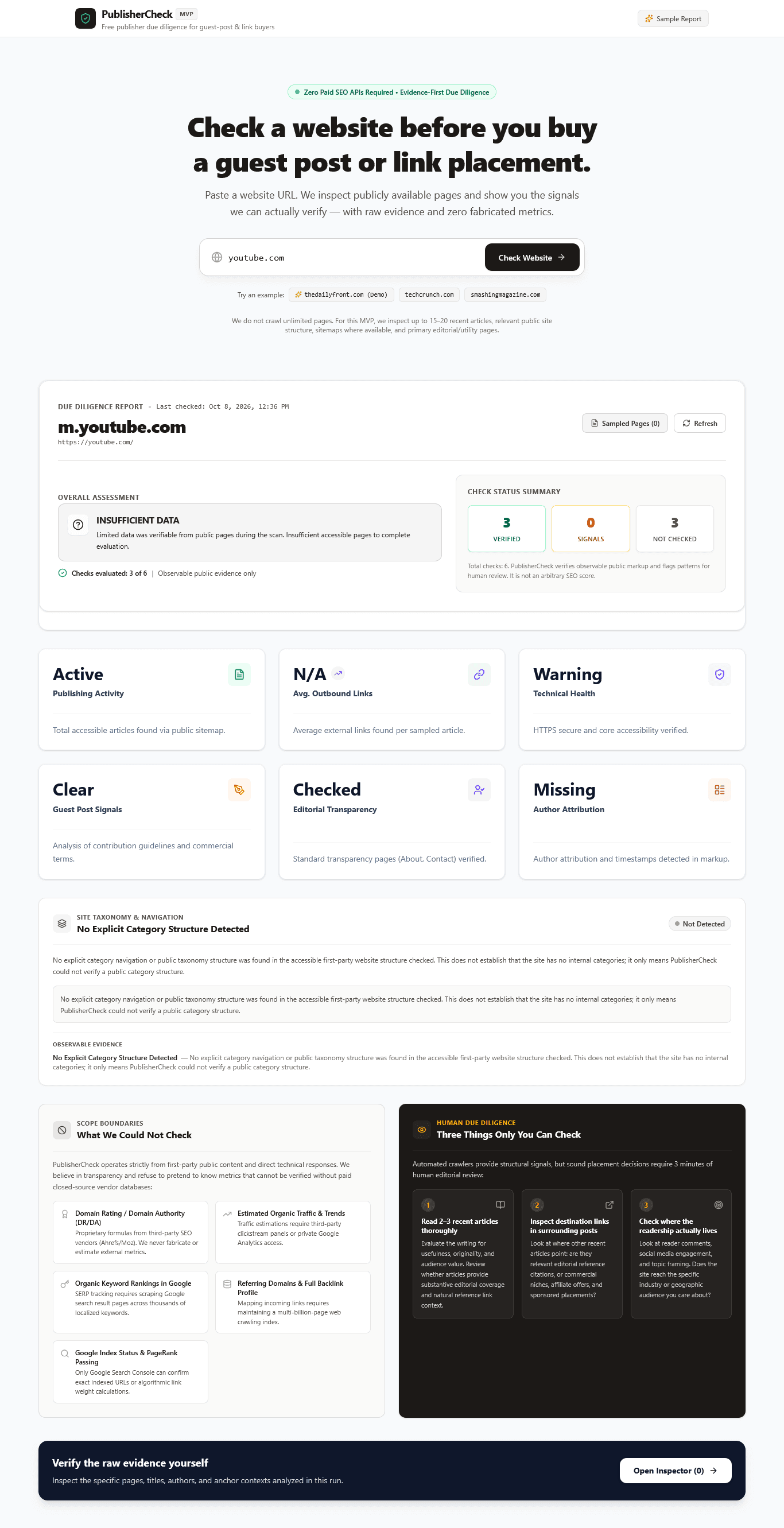
The report turns a website inspection into a compact collection of statuses that can be scanned first and investigated deeper when necessary.
Publicly accessible articles found through the site's available structure.
The interface avoids inventing a metric when the available evidence cannot support it.
HTTPS and core accessibility signals are surfaced for review.
Contribution guidelines and commercial language can be inspected.
Public transparency pages such as About and Contact can be verified.
Author attribution and timestamps are checked from publicly observable markup.
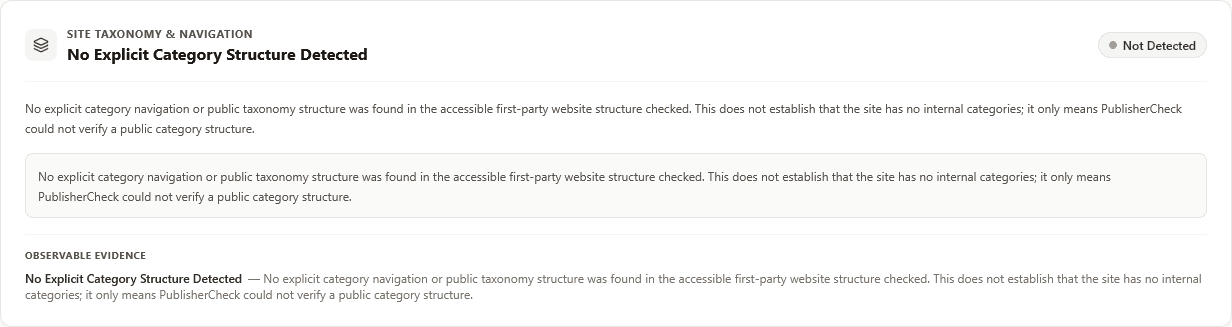
Public categories and navigation structures can reveal how a publisher organizes its content. PublisherCheck surfaces those declared structures instead of hiding them behind a score.
PublisherCheck was built as a product rather than simply a visual landing page. The interface needed to support an actual inspection flow and turn returned information into a readable report.
The experience separates automated public-evidence checks from things that require human judgment. That distinction is a core part of the product instead of being hidden in small print.
The result is a focused MVP that makes the limits of automated due diligence visible while still giving the user useful signals to investigate.
Design + Code + Product Thinking
Automated crawlers can provide structural signals. Placement decisions still require reading, context and judgment.
Review recent articles for usefulness, originality and actual editorial value.
Look at where surrounding posts point and whether the references feel editorial or commercial.
Consider comments, social engagement, topic fit and whether the readership matches the intended audience.
The final result is a live publisher inspection MVP that turns publicly observable website evidence into a structured report while clearly showing where automated analysis stops.
Deployed PublisherCheck MVP
Observable public signals instead of fabricated metrics
Automated inspection paired with human review
Good product interfaces do not always need to give users more information. Sometimes the most useful thing is making the limits of the information completely clear.
Designing the report taught me how important hierarchy becomes when a product needs to communicate multiple types of evidence at the same time.
Separating automated checks from human judgment made the product feel more honest and gave the interface a clearer purpose.
Open PublisherCheck and inspect a website through the actual due-diligence workflow, report interface and evidence sections.
Open PublisherCheck↗